
August 25, 2026

Dental Implant vs Bridge in North Phoenix: Which Is Better for One Missing Tooth?

A dental implant replaces the tooth root and can outlive a bridge by decades. A bridge is faster, needs no surgery, and costs less today, but it files down two healthy teeth and is usually replaced every 10 to 15 years. Here is how the two compare in North Phoenix, priced over 30 years.
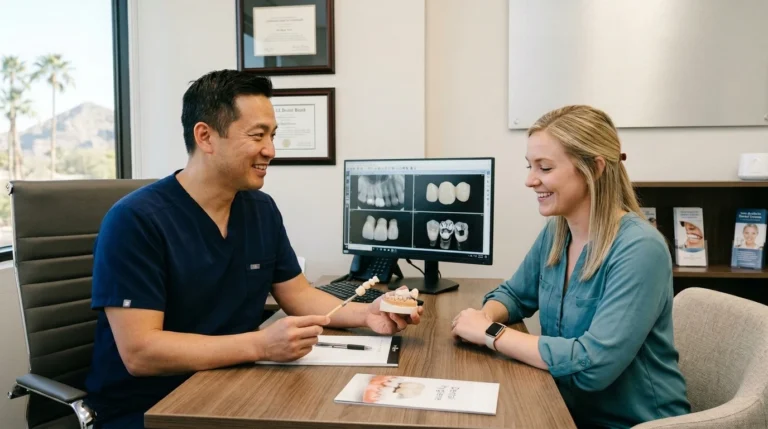
Dentist holding a dental implant model and a dental bridge model while explaining tooth replacement options to a seated patient

A dental implant vs bridge decision comes down to what each one replaces. Diamondback Dentistry's single-tooth implant package is $2,875 and replaces the root of the tooth. A bridge replaces only the visible crown. It leans on the two healthy teeth beside the gap.

That one difference drives cost, lifespan, and what happens to the bone underneath. This is general information about tooth replacement, not a diagnosis, and individual results vary. If dentures are also on the table, start with our guide to replacing missing teeth in North Phoenix.

Quick Answer

Is a dental implant or a bridge better for one missing tooth?

For a single missing tooth with healthy bone, a dental implant is usually the better long-term choice at Diamondback Dentistry in North Phoenix. It replaces the root, preserves the jawbone, and leaves the neighboring teeth untouched. Our implant package is $2,875. A bridge costs less today and needs no surgery.

Key takeaways

  • An implant replaces the root. A bridge replaces only the crown and is anchored to the two teeth on either side of the gap.
  • Diamondback Dentistry's single-tooth implant package is $2,875, against a Phoenix market range of $3,000 to $5,000. Prices vary based on individual case complexity. Request a consultation for an accurate estimate.
  • Getting a bridge means filing down two healthy teeth to hold it. That enamel does not grow back, and those teeth stay crowned for life.
  • Bone resorbs where a tooth root is missing. An implant post loads the bone the way a root did; a bridge spans the gap without touching it.
  • A bridge is cheaper today. Priced over 30 years, with replacements factored in, that gap narrows and can reverse.
  • Many dental plans cover a bridge more readily than an implant. We verify your benefits before treatment and give you the cost in writing.

What a dental implant actually replaces

A dental implant has three parts. A titanium post goes into the jawbone where the root used to be. An abutment screws into the top of that post and sits at the gumline. A crown goes on the abutment and is the only part you see.

The post is the part that matters here, and it is the part a bridge has no equivalent for. Over roughly three to six months the bone grows against the titanium surface and locks it in place, a process called osseointegration. After that the post carries chewing force down into the jaw the way a natural root did.

Nothing is done to the teeth on either side. They keep their enamel, they are not crowned, and if one of them needs work in fifteen years that work is independent of the implant. Our single tooth implant treatment page walks through the surgical side in more detail.

What a dental bridge actually replaces

A traditional three-unit bridge is one solid piece with three crowns fused together. The middle crown, called a pontic, sits over the gap and touches the gum. It does not go into the bone. The two outer crowns are cemented onto the teeth on either side, which are called abutment teeth.

To fit those two crowns, the dentist removes enamel from both abutment teeth and reshapes them into posts. This is done whether or not those teeth had anything wrong with them. Once reshaped, they need crown coverage permanently.

The trade is straightforward. No surgery, no healing period, and the finished bridge is usually in place within two to three weeks. What you give up is the enamel on two healthy teeth and any effect on the bone under the gap. See dental bridges at our North Phoenix office for how we plan and fit them.

Implant vs bridge, side by side

The table below compares the two on the eight things patients actually ask about. Longevity figures are population ranges from named dental sources, not promises about your case, and individual results vary.

Single tooth implant compared with a three-unit bridge

Clinical ranges are population figures from the American Dental Association and peer-reviewed dental literature. Individual results vary.

Comparison of a single tooth dental implant and a traditional three-unit dental bridge across eight criteria
Criterion Single tooth implant Three-unit bridge
What it replaces Root and crown Both Crown only
Surgery required Yes, minimally invasive placement under local anesthesia No
Time to finish 3 to 6 months, most of it healing 2 to 3 weeks Faster
Typical lifespan The post commonly lasts 20 years or more; the crown on top is usually replaced sooner Longer Commonly 10 to 15 years before replacement
Effect on jawbone Loads the bone, which helps preserve it Preserves Spans the gap without loading the bone beneath it
Effect on neighboring teeth None, they are left intact Intact Both are filed down and crowned permanently
Daily cleaning Brush and floss as normal Needs a floss threader or water flosser under the pontic
Price at Diamondback Dentistry $2,875 package Published Quoted in writing after your exam

What happens to the jawbone under a bridge

This is the part most patients have never been told, and it is the strongest argument on the implant side.

Jawbone maintains its volume because a tooth root pushes into it every time you chew. Remove the root and that signal stops. The bone in that spot begins to resorb, and the loss is fastest in the first year after extraction. The American Dental Association describes bone resorption following tooth loss as an expected consequence of losing the root, not an unusual complication.

A bridge does not change this. The pontic floats above the gum and never contacts the bone, so the ridge underneath keeps shrinking on its own schedule. After several years that shows up in ways patients notice: a dark triangle opening under the pontic where the gum has receded, and in larger cases a visible dip in the ridge line.

An implant post is the only one of the two that reaches the bone and loads it. That is why bone volume is the first thing we measure at a consultation, and why an implant placed sooner after extraction usually has more bone to work with than one placed years later.

First year

When most ridge resorption happens

Bone loss at an extraction site is greatest in the months immediately after the tooth comes out, then slows. Waiting years to decide between an implant and a bridge can narrow which options remain available, and grafting may be needed to rebuild the site.

Source: American Dental Association patient guidance on tooth loss and bone resorption. Individual results vary.

What each one costs in North Phoenix

Diamondback Dentistry publishes a single-tooth implant package price. We do not publish a bridge price, because bridge cost swings on the number of units, the material, and whether the abutment teeth need work first. You get that figure in writing after your exam, before anything is scheduled.

For context on the implant side: other dentists in North Phoenix quote a single implant in the range of $3,000 to $5,000, per Eden Digital's Phoenix market pricing survey. Our package sits below that range. For the crown component alone, our crown special is $650, against a Phoenix market range of $1,200 to $1,500 from the same survey.

Prices vary based on individual case complexity. Request a consultation for an accurate estimate. If you want the full cost picture including grafting and imaging, see what dental implants cost in Phoenix.

Published package price

Single Tooth Dental Implant Package

$2,875 per implant
North Phoenix Market range $3,000 to $5,000

What's included

  • Implant consultation
  • Written treatment plan
  • Surgical placement of the titanium post
  • Final restoration

Prices vary based on individual case complexity. Request a consultation for an accurate estimate. Bone grafting, extractions, and treatment of the surrounding teeth are quoted separately if your case needs them.

Book a consultation

The 30-year cost, not the sticker price

Most comparisons stop at the sticker price, note that a bridge needs replacing every 10 to 15 years, and drop the thread. Carry it through and the arithmetic changes.

Take a patient who loses a tooth at 45. On the bridge path, using the 10 to 15 year replacement interval reported in the dental literature, they are likely looking at the original bridge plus one or two replacements by age 75. Each replacement is a full remake of all three units, and each one requires re-preparing the abutment teeth.

On the implant path, the $2,875 package covers the post and the restoration. The titanium post commonly stays in service 20 years or more. The crown on top is the wearing part and is typically replaced before the post is, at roughly the cost of a single crown rather than a three-unit bridge.

Two or three bridge remakes against one implant plus a crown replacement is a genuinely different total, and in many cases the implant ends up level or ahead by year 30. This is an illustration of how the intervals stack, not a quote. Your own numbers depend on your plan, your bone, and how the abutment teeth hold up. Our guide to how long dental implants last covers the survival data behind the post figure.

The honest version: a bridge is genuinely cheaper today, and for some patients that is the deciding factor. It is not reliably cheaper by year 30.

The two teeth beside the gap

A bridge has a cost that never appears on the estimate: the two teeth holding it up.

Fitting a three-unit bridge means removing enamel from both of them, around the full circumference, down to a shape that a crown can seat on. Enamel does not grow back. Once those teeth are prepared, they need crown coverage for the rest of their lives, and if the bridge is remade later they are prepared again.

There are downstream consequences worth knowing about before you choose. Decay can start at the margin where the crown meets the tooth, and it is harder to spot there than on an open tooth surface. A prepared tooth has less structure left, so a fracture is more consequential. And because the three units are fused, a problem in one abutment tooth usually means replacing the whole bridge, not one crown.

None of this makes a bridge the wrong choice. It makes it a choice with a different bill. If both neighboring teeth already have large fillings or already need the crown that sits on top for their own reasons, that cost is one you were going to pay anyway, and a bridge starts looking efficient rather than expensive.

Who is a better fit for which

Here is the decision as we actually make it at a consultation.

An implant tends to fit patients with enough bone volume at the site, healthy gums, no uncontrolled systemic condition affecting healing, who do not smoke heavily, whose neighboring teeth are intact, and who can wait three to six months for the finished result.

A bridge tends to fit patients with insufficient bone who do not want a graft, patients whose neighboring teeth already need crowns, patients whose medical history makes surgery unwise, and patients who need the gap closed in weeks rather than months.

Bone loss on its own is not automatically disqualifying. Grafting rebuilds many sites well enough to place an implant, which adds time and cost but keeps the option open. Our page on implant options with bone loss goes through what that involves. You can also see if you are an implant candidate before booking.

What the implant timeline looks like

  1. Consultation and imaging

    We examine the site, take X-rays, measure the bone, and check the health of the neighboring teeth. You leave with a written treatment plan and a cost figure.

    One visit
  2. Grafting, only if the site needs it

    Where bone volume is short, a graft rebuilds the ridge before placement. Not every case needs this step, and it is quoted separately.

    Adds 3 to 6 months when required
  3. Placing the post

    The titanium post is placed into the jawbone under local anesthesia. This is a minimally invasive procedure, and we take steps to keep you comfortable throughout.

    One appointment
  4. Healing and osseointegration

    Bone grows against the post and locks it in place. You eat normally on the other side while this happens, and we check the site as it heals.

    3 to 6 months
  5. Abutment and final crown

    The abutment is fitted and the final crown is made to match the shade and shape of your existing teeth, then seated.

    Two visits over 2 to 3 weeks

How insurance and financing treat each one

Dental plans usually treat these two differently, and it is worth checking before you decide rather than after.

Bridges are commonly classified as a major restorative service and are covered by many plans at a percentage of the fee. Implants are treated less consistently. Some plans cover the implant portion at a percentage, some cover the crown but not the surgical placement, and some exclude implants entirely. Whichever way a plan lands, the annual maximum caps what it will pay in a calendar year. The National Association of Dental Plans reports that typical PPO annual maximums fall in the $1,000 to $1,500 range, which is below the cost of either treatment.

We accept most major PPO plans, we file claims directly for patients whether we are in or out of their network, and we verify your benefits before treatment so the number you see is the number you pay. Note that we do not offer assignment of benefits for out-of-network plans. Call to verify your benefits, since coverage varies by individual plan. You can also review dental plans we accept and how insurance covers dental implants.

Plans we accept for implants and bridges

We accept most major PPO plans. Coverage for implants and bridges varies by individual plan, so call (602) 866-8183 and we will verify your benefits at no charge before you commit to anything.

PPO plans we accept

Delta Dental PPO Humana Cigna Aetna Blue Cross Blue Shield MetLife United Healthcare Guardian Anthem Principal Ameritas Sun Life Lincoln Financial Mutual of Omaha Renaissance Dental DentaQuest

What we do not accept

DeltaCare USA is a DHMO product and we do not accept DHMO plans. Other Delta Dental PPO plans are accepted. We do not accept AHCCCS directly; AHCCCS patients are seen only through the UnitedHealthcare APIPA contractor. Medicare Advantage dental through Blue Cross, Aetna, Humana, and Cigna is accepted.

Financing

CareCredit financing is available for the portion your plan does not cover. You can prequalify with no credit impact, subject to approval. We give you the full cost in writing before treatment begins, and you can read more about dental implant financing options.

Financing

Spread the cost over monthly payments

If your annual maximum runs out partway through treatment, CareCredit covers the remainder in monthly payments. Prequalifying takes a few minutes and does not affect your credit score.

Subject to credit approval. Prequalifying with CareCredit does not affect your credit score. Financing is provided through CareCredit; Diamondback Dentistry does not determine approval or terms.

Common questions about implants and bridges

Is a dental implant better than a bridge?

For a single missing tooth with healthy bone, an implant is usually the stronger long-term option because it replaces the root, preserves jawbone, and leaves the neighboring teeth intact. A bridge is the better fit when bone is insufficient, surgery is unwise, or the adjacent teeth already need crowns. Individual results vary.

How much does a dental implant cost compared to a bridge in Phoenix?

Diamondback Dentistry's single-tooth implant package is $2,875, below the $3,000 to $5,000 range other dentists in North Phoenix quote, per Eden Digital's Phoenix market pricing survey. We quote bridges in writing after your exam, since cost depends on units and materials. Prices vary based on individual case complexity.

How long does a dental bridge last before it needs replacing?

Dental literature commonly reports a service life of 10 to 15 years for a traditional bridge before replacement is needed. How long yours lasts depends on the health of the two abutment teeth, your bite, and how well you clean under the pontic. Individual results vary.

Does dental insurance cover implants and bridges the same way?

Usually not. Many plans classify a bridge as major restorative care and cover a percentage, while implant coverage varies widely and some plans exclude implants. Annual maximums cap both; the National Association of Dental Plans reports typical PPO maximums of $1,000 to $1,500. Call to verify your benefits.

Can I get an implant if I have bone loss where the tooth was?

Often yes. Bone grafting rebuilds many sites to the volume an implant needs, which adds three to six months and a separate cost. We measure your bone at the consultation before recommending either option. Our page on implant options with bone loss covers what grafting involves.

How long does each treatment take from start to finish?

A bridge is typically finished in two to three weeks across two visits. An implant takes three to six months, because the titanium post needs time to integrate with the jawbone before the final crown goes on. Grafting, when needed, extends the implant timeline further.

Sources and references

  1. American Dental Association, patient guidance on dental implants and tooth replacement. MouthHealthy: Implants Bone resorption after tooth loss; implant structure and function
  2. American Dental Association, patient guidance on dental bridges. MouthHealthy: Bridges Bridge construction, abutment tooth preparation, cleaning requirements
  3. American Association of Oral and Maxillofacial Surgeons, dental implant procedures and bone grafting. AAOMS: Dental Implant Surgery Osseointegration timeline; grafting where bone volume is insufficient
  4. National Association of Dental Plans, dental benefits statistics. NADP: Dental Benefits Basics Typical PPO annual maximum range of $1,000 to $1,500
  5. Eden Digital Phoenix dental market pricing survey, 2026. North Phoenix ranges for single implants and crowns cited on this page

Serving North Phoenix and the surrounding Valley

We see implant and bridge patients from across the North Valley at our office on Bell Road. Open Monday through Wednesday 8:00 AM to 4:00 PM, Thursday 9:00 AM to 2:00 PM, and Saturday 8:00 AM to 1:00 PM. Closed Friday and Sunday.

Neighborhoods served

  • North Phoenix
  • Deer Valley
  • Peoria
  • Moon Valley
  • Glendale

ZIP codes in catchment

  • 85023
  • 85022
  • 85021
  • 85029
  • 85051
  • 85027

Diamondback Dentistry · 1512 W Bell Rd, Suite C-6, Phoenix, AZ 85023 · (602) 866-8183

New patients

See which option your mouth can support

The implant or bridge question is settled by an exam and an X-ray, not by an article. New patients can start with our $19 new patient special, which covers the exam and X-rays only. You leave with a written treatment plan and the cost of each option in front of you. Prices vary based on individual case complexity. Request a consultation for an accurate estimate.

Diamondback Dentistry Team

The Diamondback Dentistry team is a group of dental professionals and patient‑education specialists in Phoenix, Arizona, dedicated to making oral health information clear, accurate, and easy to act on. Our team collaborates with Diamondback Dentistry’s doctors to translate clinical expertise into patient‑friendly articles that explain treatment options, set expectations, and help you feel confident about your smile. Every piece of content we publish is created using up‑to‑date dental guidance and reviewed by a licensed dentist to ensure it reflects our current standards of care

Table of Contents

Schedule your appointment today!

Related Articles

4 Types of Dental Crowns in Phoenix: Porcelain, Zirconia, PFM, and Metal

4 Types of Dental Crowns in Phoenix: Porcelain, Zirconia, PFM, and Metal

Porcelain, zirconia, porcelain fused to metal, and full metal are…
Professional Teeth Whitening vs. Over-the-Counter Kits in North Phoenix

Professional Teeth Whitening vs. Over-the-Counter Kits in North Phoenix

Professional whitening and store-bought kits both use peroxide, at very…