A dental implant has two parts that age differently. The titanium post in your jaw can stay for decades, because what holds it is the bone around it, and that bone stays healthy largely when the gum over it does. The crown on top takes the chewing, and it's the part that sometimes gets tightened, repaired or replaced. Whether the post lasts is decided mostly by things you and your dentist can see coming: gum disease, smoking, grinding and how often the implant is checked.
Can a dental implant last the rest of your life?
Often, though nobody can promise it. In long-term studies, about 96 percent of implants were still in place at 10 years and 93 percent at 20. The crown on top is repaired or replaced more often than the post. What decides the post's lifespan is the health of the gum and bone around it.
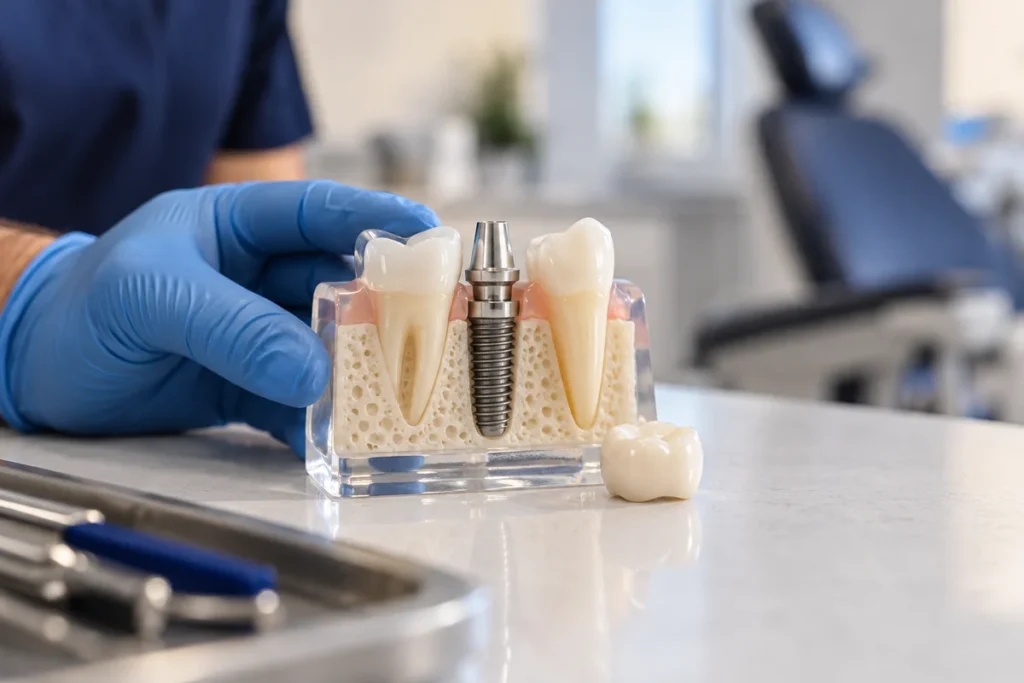
The Titanium Post and the Crown Wear Out on Different Clocks
The post stays as long as the bone around it does
After the post is placed, bone grows tightly against the titanium over the following months, a process called osseointegration. That bond is what keeps the post in place, so an implant's long life depends on the bone and the gum that protects it staying healthy.
Some implants never bond with the bone in the first place, and those losses show up early, during healing after implant placement. Later losses have a different mix of causes. In prospective studies that followed implants for 20 years or more, the failures with a reported cause were split about evenly between biological problems in the gum and bone and mechanical problems with the parts (Lupi and colleagues, 2026).
The crown and its screw take the daily wear
The crown is the tooth you see. It's fixed to the post through a connector called an abutment, usually held by a small screw, and it takes every bite. A review of 46 studies of single-tooth implants in Clinical Oral Implants Research measured the two parts separately: at 10 years, 95.2 percent of the implants were still in place, and 89.4 percent of the crowns on them were (Jung and colleagues, 2012). Within 5 years, 8.8 percent of the crowns had a screw work loose, and smaller shares had come unseated or chipped.
That gap is why the familiar line that an implant crown "lasts 10 to 15 years" is too tidy. A crown isn't on a timer. It's the part that can be tightened, repaired or remade, usually without disturbing the post underneath.
What Studies Following Implants for 10 and 20 Years Found
Research reports survival, which means the implant is still in the mouth. That isn't the same as success, which means it's still healthy. An implant can survive with inflamed gum or some bone loss around it, so the survival figures count implants that are still there, not implants that are problem-free.
- 5 years: 97.2 percent of implants carrying a single crown were still in place, across 46 studies (Jung and colleagues, 2012).
- 10 years: 96.4 percent across 18 prospective studies of modern implants in adults. When the researchers allowed for patients who dropped out of follow-up, the estimate was 93.2 percent (Howe and colleagues, Journal of Dentistry, 2019).
- 20 years: 93.0 percent, from 10 prospective studies in which 1,028 implants were followed for 20 years or more (Lupi and colleagues, International Journal of Oral and Maxillofacial Surgery, 2026).
These are averages from thousands of implants studied under research conditions. They show that implants hold up well as a group; they can't predict what happens to one implant in one mouth. If you're choosing between an implant and a bridge, the years are only part of the decision, and how an implant compares with a bridge covers the rest.
Gum Disease, Smoking and Grinding Shorten an Implant's Life
The biggest long-term threat to an implant is disease in the gum and bone around it. In the early form, peri-implant mucositis, only the gum is inflamed. When the inflammation reaches the bone, it's called peri-implantitis, and the bone holding the post starts to break down. A 2025 review for the Academy of Osseointegration and the American Academy of Periodontology, covering 102 studies and more than 13,000 patients, found peri-implantitis in about 1 in 5 of the patients studied (Galárraga-Vinueza and colleagues).
These are the factors the evidence ties most clearly to that disease, or to losing an implant:
- A history of gum disease. In an umbrella review of 41 meta-analyses, periodontitis carried about 3.8 times the odds of peri-implantitis, one of the two strongest links found (Giok and colleagues, 2024).
- Smoking. The same review found about twice the risk of peri-implantitis in smokers (Giok and colleagues, 2024).
- Diabetes that isn't well controlled. One review put the odds of peri-implantitis at 2.5 times higher with diabetes (Dreyer and colleagues, 2018).
- Grinding or clenching. Implants in people with probable bruxism had about twice the odds of failing (Häggman-Henrikson and colleagues, 2023).
- Plaque left around the implant. Poor plaque control is one of the risk factors with the strongest evidence behind it (Schwarz and colleagues, 2018).
- Skipped maintenance visits. This is the one most within your control, and the numbers are in the upkeep section below.
None of these rules an implant out, and none decides what happens to yours. They're the reasons a dentist asks about your gums, your health and your habits before an implant goes in and at every visit after.
How do you spot trouble around an implant early?
The American Academy of Periodontology notes that the gum-only stage can be reversed when it's caught in time, while peri-implantitis usually needs surgical treatment. Some changes are easy to miss at home, which is why a dentist checks the gum around an implant with a probe and compares X-rays over time (Schwarz and colleagues, 2018). Between visits, these are the signs worth acting on:
- Red, swollen or tender gum around the implant
- Bleeding when you brush or clean around it
- Gum pulling back, so more of the crown or the metal shows
- Pus or a bad taste near the implant
- A crown that feels loose, or a bite that suddenly feels different
- Soreness around the implant that doesn't settle
If you notice any of these, call (602) 866-8183 rather than waiting for your next cleaning. Severe swelling in the face with trouble breathing or swallowing is different: call 911 or go to an emergency room.
Daily Cleaning and Regular Checkups Keep the Bone Around an Implant Healthy
At home, an implant needs the same care as a natural tooth: brushing and cleaning between teeth every day, with regular checkups, which is what the American Academy of Periodontology advises. Pay attention to where the crown meets the gum, because plaque there is what starts the inflammation.
Maintenance is where you have the most control, and the difference it makes is large. In a review of 57 studies, the median rate of peri-implantitis was 9.0 percent among people in a regular maintenance program and 18.8 percent among people without one (Dreyer and colleagues, 2018). In controlled trials, people receiving supportive care had about a quarter of the peri-implantitis seen in people without it (Lin and colleagues, 2019). Regular cleanings and exams let a dentist catch gum changes while they're still the reversible kind. If you grind your teeth at night, ask whether a night guard makes sense for you.
If your implant hasn't been checked in years, or it was placed at a practice you no longer visit, you don't need to explain the gap. At Diamondback Dentistry, the visit starts from where things stand today: the dentist checks the implant and the gum around it, then explains what they find and what, if anything, it needs. If you're still deciding on an implant, dental implant treatment at Diamondback starts the same way, with an exam and a plan explained before anything begins.

Other Questions About Implant Lifespan
Does age change how long an implant lasts?
▾
Can a dental implant get a cavity?
▾
Can a failed implant be replaced?
▾
Can you get an implant if you smoke or have diabetes?
▾
How often should an implant be checked?
▾
Sources
- Howe M-S, Keys W, Richards D. Long-term (10-year) dental implant survival: a systematic review and sensitivity meta-analysis. Journal of Dentistry, 2019. doi.org/10.1016/j.jdent.2019.03.008
- Jung RE, Zembic A, et al. Systematic review of the survival rate and the incidence of biological, technical, and aesthetic complications of single crowns on implants reported in longitudinal studies with a mean follow-up of 5 years. Clinical Oral Implants Research, 2012. doi.org/10.1111/j.1600-0501.2012.02547.x
- Lupi S, Agolli J, et al. Dental implant survival and marginal bone loss after a minimum of 20 years: systematic review and meta-analysis of prospective studies. International Journal of Oral and Maxillofacial Surgery, 2026. doi.org/10.1016/j.ijom.2026.05.011
- Galárraga-Vinueza ME, Pagni SE, et al. Prevalence, incidence, systemic, behavioral, and patient-related risk factors and indicators for peri-implant diseases: an AO/AAP systematic review and meta-analysis. Journal of Periodontology, 2025. doi.org/10.1002/jper.24-0154
- Giok KC, Veettil SK, Menon RK. Risk factors for peri-implantitis: an umbrella review of meta-analyses of observational studies and assessment of biases. Journal of Dentistry, 2024. doi.org/10.1016/j.jdent.2024.105065
- Dreyer H, Grischke J, et al. Epidemiology and risk factors of peri-implantitis: a systematic review. Journal of Periodontal Research, 2018. doi.org/10.1111/jre.12562
- Wada M, Mameno T, et al. Prevalence and risk indicators for peri-implant diseases: a literature review. Japanese Dental Science Review, 2021. doi.org/10.1016/j.jdsr.2021.05.002
- Häggman-Henrikson B, Ali D, et al. Bruxism and dental implants: a systematic review and meta-analysis. Journal of Oral Rehabilitation, 2023. doi.org/10.1111/joor.13567
- Schwarz F, Derks J, et al. Peri-implantitis. Journal of Clinical Periodontology, 2018. doi.org/10.1111/jcpe.12954
- Lin C-Y, Chen Z, et al. The effect of supportive care in preventing peri-implant diseases and implant loss: a systematic review and meta-analysis. Clinical Oral Implants Research, 2019. doi.org/10.1111/clr.13496
- Monje A, Aranda L, et al. Impact of maintenance therapy for the prevention of peri-implant diseases: a systematic review and meta-analysis. Journal of Dental Research, 2016. doi.org/10.1177/0022034515622432
- Wang H-L, Calatrava J, et al. Long-term periodontal and peri-implant tissue stability under supportive therapy. Periodontology 2000, 2026. doi.org/10.1111/prd.70038
- American Academy of Periodontology. Peri-Implant Diseases. www.perio.org/for-patients/gum-disease-information/peri-implant-diseases/
Plan Your Implant Visit at Your Own Pace
If you're deciding on an implant, a consultation is where the dentist looks at your gums and bone, walks you through what to expect, and answers your questions. If you already have an implant that hasn't been checked in a while, book a regular visit and we'll start there.