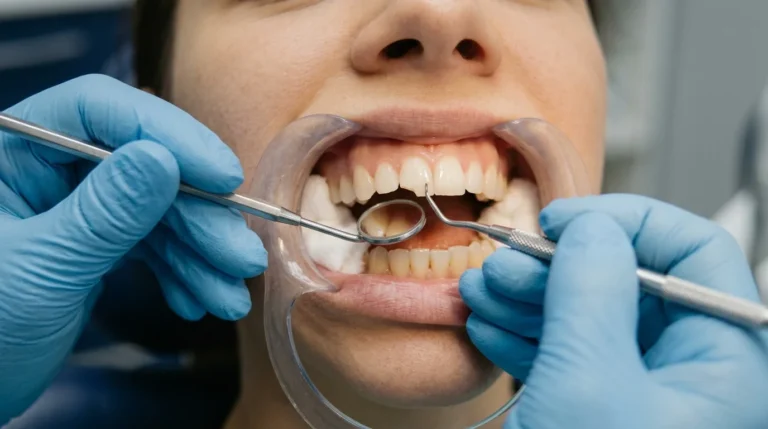
Severe tooth pain, a knocked-out tooth, or swelling in your face or jaw all point the same direction: call an emergency dentist in North Phoenix today. Diamondback Dentistry treats dental emergencies at (602) 866-8183. Not every dental problem needs same-day care, though, and a few need more than a dentist can give you. This page sorts them into three groups so you can tell which one you have.
Is this a dental emergency?
Call an emergency dentist in North Phoenix today for a knocked-out tooth, severe or worsening pain, or swelling around a tooth. Go to an emergency room now instead if you have trouble breathing or swallowing, spreading facial swelling, or bleeding that will not stop after 15 minutes of firm pressure.
Three things to do in the next 30 minutes
- 01Rule out the emergency room first. Trouble breathing or swallowing means call 911, not a dental office.
- 02Save what came out. A knocked-out permanent tooth needs to reach a dentist within 30 minutes, per the American Association of Endodontists. Keep it moist.
- 03Call before noon. We are open Monday through Wednesday 8 AM to 4 PM, Thursday 9 AM to 2 PM, and Saturday 8 AM to 1 PM. Calling early gives us the best chance of fitting you in the same day.
What counts as a dental emergency
A dental emergency is a problem where waiting makes the outcome worse. That is the whole test. A chip that looks bad but does not hurt is not urgent. A tooth dying quietly under an old filling is. Pain is a useful signal but not the only one, because infection and tooth loss can both progress with very little warning.
The American Dental Association draws the sharpest line at the top end, defining a true dental emergency as potentially life threatening: uncontrolled bleeding, a spreading soft-tissue infection with swelling that could compromise the airway, or facial-bone trauma. Everything below that line still matters, but it is a dental appointment rather than an ambulance.
See a dentist today
| What you have | Why it cannot wait |
|---|---|
| Knocked-out permanent tooth | The window for saving it is measured in minutes |
| Severe pain, or pain getting worse | Usually means the nerve is involved, and it rarely settles on its own |
| Broken tooth with a pink or red center | The nerve is exposed and open to bacteria |
| Swelling in the gum, cheek, or jaw | Suggests infection, which spreads rather than resolves |
| Lost crown or filling on a tooth that hurts | The tooth is unprotected and can fracture further |
| A tooth knocked loose or out of position | Repositioning is time-sensitive |
What can usually wait
If it has been a while since your last visit, that is okay. None of these needs you to rearrange your day: a chipped tooth with no pain or sharp edge, a crown that came off cleanly and does not hurt, a dull ache that responds to over-the-counter pain relief, food caught between teeth, a cracked night guard, or mild cold sensitivity that fades within seconds.
Book these in the normal way. If pain arrives or swelling starts, it moves up to the table above. Our guide to the signs you should see a dentist covers the slower-moving symptoms.
When to go to an emergency room instead
Some dental problems are medical problems. A dental office can treat the tooth, but it cannot manage an airway or a systemic infection.
Signs this is beyond a dental office
Call 911 if you have trouble breathing or swallowing. Go to an emergency room now, rather than calling us, for any of these:
- Difficulty breathing or swallowing, or swelling of the tongue or floor of the mouth
- Swelling spreading toward the eye or down the neck
- Fever with facial swelling, which suggests the infection is no longer local
- Bleeding that will not stop after 15 minutes of firm, continuous pressure
- A suspected broken jaw, or a jaw that will not close properly
- A head injury or loss of consciousness after a blow to the face
These mirror the American Dental Association's definition, which centers on uncontrolled bleeding, spreading infection near the airway, and facial-bone trauma. Worth knowing before you go: an emergency department can manage pain, drain an abscess, and prescribe antibiotics, but most are not equipped to extract a tooth, perform root canal treatment, or place a crown. The dental problem will still need a dentist afterward.
Getting care outside our hours
We are not a 24-hour practice, so here are our real hours. Monday through Wednesday, 8 AM to 4 PM. Thursday, 9 AM to 2 PM. Saturday, 8 AM to 1 PM. We are closed Friday and closed Sunday. If a red-flag sign above applies, an emergency room is the right call at any hour. If none does, use the steps below and call us at (602) 866-8183 when we open.
First aid before you get to the office
These are holding measures. They protect the tooth and buy time, and none replaces treatment.
Knocked-out tooth
The American Association of Endodontists is specific here. Pick the tooth up by the crown, the chewing surface, not the root. If it is dirty, rinse it gently with water only. Do not scrub it, dry it, or use soap. Push it gently back into the socket if you can. If you cannot, keep it moist in milk or held inside your cheek, not in tap water. Then reach a dentist within 30 minutes. The AAE notes a tooth can sometimes still be saved after an hour or more, so it is worth trying even past that window.
Broken or chipped tooth
Save any fragments. Rinse with warm water and hold a cold compress against the outside of your cheek. If a sharp edge is cutting your tongue or lip, cover it with dental wax until you are seen. We can often repair a broken or chipped tooth in one visit, depending on how deep the fracture runs.
Lost crown or filling
Keep the crown and bring it, because it can often be re-cemented. Avoid chewing on that side. Do not use household glue, which can damage the tooth underneath and turn a simple repair into a complicated one.
Swelling or a suspected abscess
This is where waiting costs the most. Rinse with warm salt water. Do not apply heat to your face, and do not lance or squeeze the swelling. If it spreads, or you develop a fever, go back to the emergency room criteria above.
What happens at an emergency visit at Diamondback Dentistry
An emergency visit starts with getting you out of pain and finding out why you are in it. We provide emergency dental care in North Phoenix from our office at 1512 W Bell Rd, Suite C-6, Phoenix, AZ 85023. The first appointment is short and focused, and it is not the visit where we fix everything.
Expect an exam of the area, an X-ray of the tooth involved, and a diagnosis in plain terms. Before treatment starts, you get the cost in writing. We accept most major PPO plans, verify your benefits at no charge, and file the claim for you. Our new patient visit information covers what to bring.
What we can often treat the same day
If you call before noon, we will do our best to see you the same day, though we cannot promise a slot on any given date. Depending on what the exam shows, treatment that can often begin at that first visit includes emergency tooth extraction, root canal treatment, and broken tooth repair. A crown needs a second appointment, because the restoration is made in a dental laboratory.
We quote treatment per case after the exam rather than publishing a price list, because the same symptom can mean very different work. Prices vary based on individual case complexity. Request a consultation for an accurate estimate.
Common questions about dental emergencies
How do I know if my tooth pain is an emergency?
▾
Can I go to an emergency room for a toothache?
▾
What should I do with a knocked-out tooth?
▾
Does insurance cover emergency dental visits?
▾
How much does an emergency dental visit cost in North Phoenix?
▾
Sources and references
- Definition of a dental emergency, including uncontrolled bleeding, spreading infection near the airway, and facial-bone trauma. American Dental Association, Emergency Treatment Referenced in "What counts as a dental emergency" and "When to go to an emergency room instead". Accessed 20 August 2026.
- What an emergency department can and cannot treat for a dental problem. American Dental Association, Emergency Department Referrals Referenced in "Signs this is beyond a dental office" and the FAQ. Accessed 20 August 2026.
- Handling, storage, and the 30-minute window for a knocked-out permanent tooth. American Association of Endodontists, Knocked-Out Teeth Referenced in "Three things to do in the next 30 minutes", "Knocked-out tooth", and the FAQ. Accessed 20 August 2026.
Call us in North Phoenix
If you are in pain or something has broken, call rather than message. We are open Monday through Wednesday 8 AM to 4 PM, Thursday 9 AM to 2 PM, and Saturday 8 AM to 1 PM, and closed Friday and Sunday. Call before noon and we will do our best to see you the same day. We accept most major PPO plans and will verify your benefits at no charge.
Service area
We see emergency patients from across the North Valley, along the Bell Road and I-17 corridor.
Neighborhoods served
- North Phoenix
- Deer Valley
- Peoria
- Moon Valley
- Glendale
Diamondback Dentistry · 1512 W Bell Rd, Suite C-6, Phoenix, AZ 85023 · (602) 866-8183