If you have been looking up how much dental implants cost, you have probably seen figures for a single tooth that run from under $2,000 to over $6,000, sometimes on the same page. Most of them are not wrong. They are counting different things, and once you know what a figure counts, the gap between them mostly closes.
How Much Is a Dental Implant, All In?
For one finished tooth, expect roughly $3,000 to $6,000, the range Penn Dental Medicine gave in 2025. Cost studies that price the implant post alone land near $2,100, both nationally and in Arizona (CareCredit, 2024). Removing a tooth first, bone grafting and 3D imaging can add to either figure.
Get a Number for Your Own Tooth
An average describes thousands of mouths. An implant consultation is where we look at yours and work out what it would need.
Why Implant Cost Averages Disagree by Thousands
The National Figures, Read Side by Side
CareCredit's 2025 cost guide, which draws on a 2024 procedural cost study ASQ360 Market Research conducted for Synchrony, the company behind CareCredit, puts the national average for a single implant at $2,143. That figure covers placing the implant post, the artificial root, and leaves the crown out. The same guide prices a crown on its own at $488 to $3,254 in its 2023 study, depending on the material.
Penn Dental Medicine, the University of Pennsylvania's dental school, puts the average cost of replacing a single tooth at $3,000 to $6,000 in a 2025 article on implant options. That is the finished tooth. Add a mid-priced crown to the $2,143 post and you land inside Penn's range, so the two sources agree more than they first appear to. When a quote looks low next to that range, the first thing to check is whether it includes the crown.
What Arizona's Figure Means for Phoenix
The same 2024 study gives Arizona a state average of $2,138 for the implant post, a few dollars under the national figure. Like the national number, it leaves out the crown, any extraction and office fees.
We could not find a neutral, dated average for Phoenix alone. Most Phoenix figures online come from practices pricing their own work, or from sites that do not say where their numbers come from, which makes them prices rather than averages. For the post itself, Arizona tracks the national figure almost exactly, so the finished-tooth range above is the better guide to a total here too.
What You Pay For in One Dental Implant
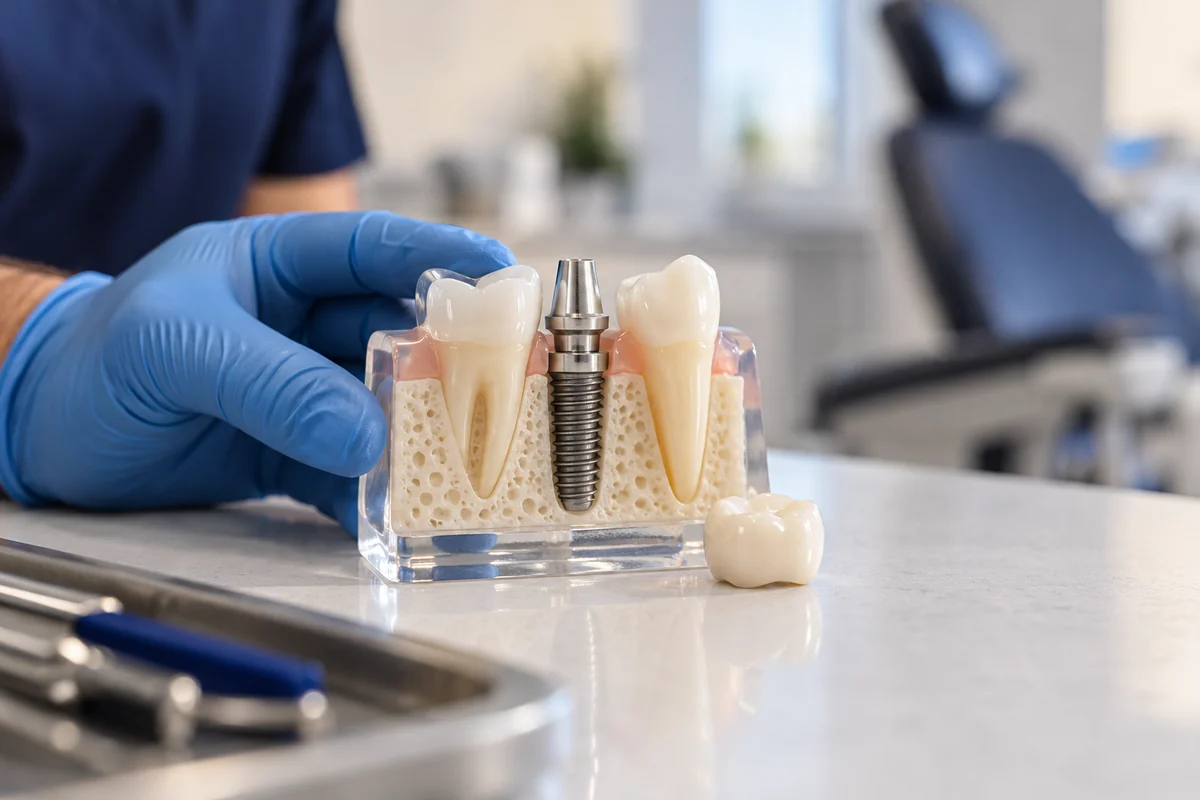
The cost of one dental implant is the cost of three parts, and each has its own job. The U.S. Food and Drug Administration describes them this way:
- The implant body: a post placed in the jawbone where the tooth's root used to be.
- The abutment: the piece that attaches to the post, usually with a small screw, and holds the tooth.
- The crown: the part you see and chew with. Cost studies often price it separately, as the national figures above do.
Single tooth implants are one of several implant treatments we offer, from one tooth to a full arch, and dental implants at Diamondback covers each of them.
Some cases need more before or between those parts, and each step adds to the total:
- Removing a failing tooth. If the tooth is still there, it has to come out first. That is a separate procedure, and cost studies such as the 2024 one leave it out.
- A bone graft. Where the jawbone is too thin to hold a post, the site may need a graft before the implant goes in (Elboraey and colleagues, 2025).
- 3D imaging. The American Academy of Oral and Maxillofacial Radiology recommends cross-sectional imaging to assess every implant site, with cone beam CT as its method of choice (2012). Newer guidance from the ADA and the same academy asks dentists to decide on each scan patient by patient (2026).
- Healing time. The FDA notes that healing after placement may take several months or longer, so the crown comes at a later visit and the treatment runs across several appointments.

Why a Real Quote Needs an Exam
The averages describe other people's mouths. What decides your number is how much bone there is where the tooth was, whether a tooth has to come out first, how many teeth are being replaced, and what the imaging shows. None of that can be judged over the phone, which is why we quote each case after an exam rather than from a price list. When you're ready for a figure, your own implant quote starts with that visit.
Whichever office you see, ask for the quote to name each of these, so two quotes can be compared line by line:
- the implant post, the abutment and the crown, and what the crown is made of
- any extraction
- any bone graft
- the imaging
- the follow-up visits
At the exam, your dentist will explain what was found, what the options are and why each part of the plan is there. Questions are welcome, and you can understand the recommendation before you decide anything.
Find Out What Your Implant Would Cost
Request an implant consultation online, or call and talk with the team first if you have questions about the visit.
How Do Insurance and Financing Fit In?
Dental plans that cover implants usually treat them as a major procedure. The National Association of Dental Plans says major work is usually paid at the plan's lowest share, such as 50 percent, and that some carriers now include implants in that category with a limit on how often. Every plan also has a yearly maximum, and NADP reports that about 65 percent of PPO plans set it at $1,500 or more. Next to the cost of a finished implant, that maximum can be the real limit on what a plan pays in one year.
We accept most PPO plans, file the claim for you with the plans we accept and with out-of-network plans, and check your benefits for free. We don't take assignment of benefits for out-of-network plans, so that plan's payment goes to you rather than to us. Plans differ widely in how dental insurance treats implants, so call us and we'll check what yours would pay.
CareCredit lets you prequalify for financing, subject to approval, and there are other ways to pay for an implant over time if the part your plan leaves is more than you want to pay at once.
Other Questions About What Implants Cost
Does waiting to replace a missing tooth change the cost?
▾
Does Medicare pay for dental implants?
▾
Is an implant a one-time cost?
▾
Does each missing tooth need its own implant?
▾
Does the crown material change the price?
▾
Sources
- CareCredit (Synchrony). Dental Implants Cost and Procedure Guide, 2025. Figures from the 2024 and 2023 Synchrony Average Procedural Cost Studies, conducted by ASQ360 Market Research. carecredit.com National and Arizona single-implant averages, implant post only; crown price range.
- Penn Dental Medicine. 3 Cost-Effective Tooth Implant Options, 2025. penndentalmedicine.org Average cost of replacing a single tooth.
- U.S. Food and Drug Administration. Dental Implants: What You Should Know. fda.gov The parts of an implant; healing time; implants supporting crowns, bridges or dentures.
- Tyndall D, et al. Position statement of the American Academy of Oral and Maxillofacial Radiology on selection criteria for the use of radiology in dental implantology with emphasis on cone beam computed tomography. Oral Surgery, Oral Medicine, Oral Pathology and Oral Radiology, 2012. doi.org/10.1016/j.oooo.2012.03.005 Cross-sectional imaging for implant sites.
- Benavides E, et al. American Dental Association and American Academy of Oral and Maxillofacial Radiology patient selection for dental radiography and cone-beam computed tomography. Journal of the American Dental Association, 2026. doi.org/10.1016/j.adaj.2025.10.013 Imaging decided patient by patient.
- Elboraey M, et al. Regenerative approaches in alveolar bone augmentation for dental implant placement. Journal of Dentistry, 2025. doi.org/10.1016/j.jdent.2025.105612 Bone augmentation before implant placement.
- Tan W, et al. A systematic review of post-extractional alveolar hard and soft tissue dimensional changes in humans. Clinical Oral Implants Research, 2012. doi.org/10.1111/j.1600-0501.2011.02375.x Bone changes in the six months after an extraction.
- Jung R, et al. Systematic review of the survival rate and the incidence of biological, technical, and aesthetic complications of single crowns on implants. Clinical Oral Implants Research, 2012. doi.org/10.1111/j.1600-0501.2012.02547.x Ten-year survival of implants and of the crowns on them.
- National Association of Dental Plans. Understanding Dental Benefits. nadp.org Major-procedure share, implants as major work, PPO annual maximums.
- Medicare.gov. Dental services. medicare.gov What Original Medicare does not cover.
If Cost Kept You Away, You Are Still Welcome Here
If cost is why you have put off replacing a tooth, you don't need to explain that. Your first visit is about where things stand now and what an implant would take. No lectures, just a way forward.