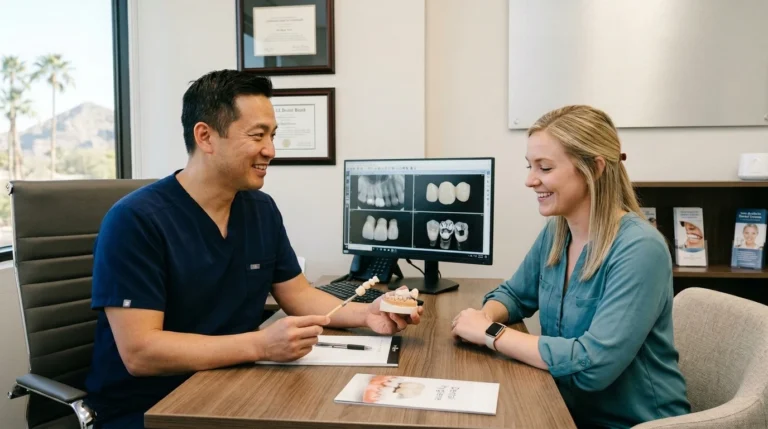
Knowing how to choose a dental insurance plan comes down to 8 checks, and in Phoenix the first one is whether your current dentist takes the plan at all. Most open-enrollment guides are written by the companies selling the plans, so they lead with premiums. Diamondback Dentistry sees the other end of that decision every January in North Phoenix, when a patient learns their new plan cannot be used here. This guide runs the checks in the order that actually costs you money.
How do you choose a dental insurance plan in Phoenix?
Run 8 checks before you enroll: whether your dentist takes the plan, PPO or DHMO, the annual maximum, the deductible, the coverage tiers, waiting periods, exclusions, and total yearly cost. Diamondback Dentistry in North Phoenix accepts 19 carriers on PPO plans and no DHMO plans.
Key Things to Know Before You Enroll
- 01Open enrollment on the health insurance marketplace runs November 1 to January 15. Enroll by December 15 for coverage starting January 1, per HealthCare.gov.
- 02Most dental benefits expire on December 31 and do not roll over into the next year, per the American Dental Association.
- 03A DHMO plan cannot be used at Diamondback Dentistry. We accept PPO plans, and DeltaCare USA is a DHMO product we do not accept.
- 04Check the network before the premium. A plan is locked for twelve months, so a small monthly saving can cost you the dentist you already trust.
Why Plan Choice Matters More Than Premium in Phoenix
A dental plan is a twelve-month commitment. Once the enrollment window closes you generally keep what you picked until the next one, which means a November decision governs every cleaning, filling and crown you have through the following December.
That is a different decision from most insurance shopping. You are not just buying a price. You are choosing which dental offices you can walk into.
The Local Context: Enrollment Dates and the Snowbird Calendar
Marketplace open enrollment runs from November 1 through January 15, and HealthCare.gov advises enrolling by December 15 if you want coverage effective January 1. Employer benefit windows usually land in November. Arizona uses the federal marketplace, and ten insurers offered standalone individual and family dental coverage there for 2026, according to healthinsurance.org.
Phoenix adds a wrinkle. Seasonal residents arrive from October onward, so the local appointment calendar tightens exactly when new benefits reset. If you plan to use a January benefit, book early.
Who This Applies To
Five groups face this each fall: people picking from an employer menu, people buying a standalone marketplace plan, people aging into Medicare Advantage with a dental rider, people covered through AHCCCS, and people deciding whether to carry coverage at all. The checks below apply to all five. The fine print just sits in different places. On the Medicare side, our page on Medicare dental coverage in Arizona covers what those riders typically include.
The 8 Checks Before You Pick a Plan
Work these in order. The first two are the ones that cannot be undone until the next enrollment window.
1. Whether Your Dentist Takes the Plan
Start here. Confirm that the specific plan, not just the carrier, works at the office you want to keep. Carrier and plan are not the same thing. A practice can accept a carrier's PPO products and not accept that same carrier's DHMO product.
Why It Matters
Every other variable on this list is money. This one is access. If the plan does not work at your office, the deductible and the annual maximum stop mattering, because you are either paying out of pocket or finding a new dentist in January. Diamondback Dentistry accepts 19 carriers on PPO plan types, listed below, and files claims directly for patients.
What to Do About It
Write down the exact plan name from the enrollment form, not just the carrier logo, then check it against the dental plans we accept. Carrier directories go stale, so treat the office as the more reliable answer.
When to Call the Office
Call us at (602) 866-8183 before you submit the form if the plan name is unfamiliar or includes the letters HMO, DMO or DHMO. We verify benefits at no charge.
2. PPO or DHMO
Dental plans divide into two broad families. A PPO lets you see any licensed dentist and pays more when that dentist is in the plan's network. A DHMO is narrower. It assigns you to a primary dental office, charges set copays, and generally pays nothing outside that assignment.
Why It Matters
DHMO premiums are usually the lowest on the menu, which is why people pick them under time pressure. Diamondback Dentistry does not accept DHMO, HMO, DMO or capitation plans. That includes DeltaCare USA, a DHMO product, even though we do accept Delta Dental PPO plans. Patients often assume one Delta product implies all of them, and it does not.
What to Do About It
If keeping this practice matters, the choice is a PPO. If a DHMO is the only plan your employer offers, call before you enroll. Our Delta Dental PPO page spells out which Delta products work here.
When to Call the Office
Call if your plan documents use the words capitation, copay schedule, or assigned facility. Those three terms usually signal a DHMO structure rather than a PPO.
PPO and DHMO Side by Side
The practical differences that decide whether a plan works at a given office.
| What you are comparing | PPO | DHMO |
|---|---|---|
| Choice of dentist | Any licensed dentist, with better pricing in network More flexible | Assigned primary dental office only |
| Monthly premium | Higher | Lower |
| How your share is set | A percentage of the plan's allowed amount | A fixed copay per procedure |
| Referral to see a specialist | Usually not required | Usually required |
| Accepted at Diamondback Dentistry | Yes, 19 carriers Accepted | No, including DeltaCare USA |
3. The Annual Maximum
The annual maximum is the ceiling on what the plan will pay for you in a benefit year. It is a hard stop. According to the National Association of Dental Plans, most dental network and indemnity plans set that ceiling between $1,000 and $1,500, and 73 percent of dental PPO enrollees now have a maximum of $1,500 or more.
Why It Matters
Preventive care rarely comes close to the ceiling. One dental crown can consume a large share of it. If you already know you have restorative work ahead, the maximum decides more about your year than the premium does.
What to Do About It
Compare the maximum against the work you expect, then check whether it resets on January 1 or on the plan's own anniversary date. Those are not always the same.
When to Call the Office
Call if you have treatment already planned. We can tell you roughly how much of a maximum it tends to use, which makes two plans easier to compare.
4. The Deductible and What It Does Not Apply To
The deductible is what you pay before the plan starts paying. On most dental plans it is a modest figure, and most plans waive it entirely for preventive and diagnostic care.
Why It Matters
Because preventive care is usually exempt, the deductible is really a basic-and-major-services number. That distinction matters. Two plans advertising the same deductible can behave very differently depending on which tiers it attaches to.
What to Do About It
Read which tiers the deductible applies to, and check whether it is per person or per family. A family deductible on a household of four is a different figure than it first appears.
When to Call the Office
Call if the summary is unclear about whether preventive care is exempt. That one line changes what a cleaning costs you.
5. The Coverage Tiers
Dental plans sort treatment into three tiers. Each tier pays a different share. The common pattern is preventive and diagnostic care at 100 percent, basic services around 80 percent, and major services around 50 percent, per the American Dental Association.
Why It Matters
Those percentages apply to the plan's allowed amount, not to the practice's fee, which is why a plan paying 50 percent does not always leave you paying half. Tier placement also varies between plans, so a service one plan calls basic another may call major. Our guide to what dental insurance actually covers walks through the tiers in more detail.
What to Do About It
Check which tier holds the services you actually use. If you get two cleanings a year and little else, strong preventive coverage matters more than a high major-services percentage. See what a cleaning and exam includes.
When to Call the Office
Call if a plan places a service you need in an unexpected tier. We can explain what that reclassification does to your share.
6. Waiting Periods and Missing Tooth Clauses
Many plans make you hold coverage for a set period before paying for major work. A missing tooth clause is a separate exclusion, and it means the plan will not pay to replace a tooth you lost before the plan began.
Why It Matters
A waiting period can push a crown or a bridge into the following benefit year, which doubles the time and the premium it takes to get the work done. According to healthinsurance.org, Arizona requires carriers to credit prior dental coverage toward a waiting period when the gap between plans is no more than 63 days.
What to Do About It
If you are switching, avoid a lapse and keep proof of your prior plan so the credit can be applied. If you have a tooth to replace, read the missing tooth clause first.
When to Call the Office
Call if you have work in progress. Treatment spanning a plan change needs sequencing, and that is easier before the switch than after.
7. What the Plan Will Not Cover at All
Every dental plan carries exclusions. Cosmetic treatment is almost always excluded. Adult orthodontics is frequently excluded. Dental implants are commonly excluded or capped well below the cost of the work.
Why It Matters
Exclusions are where a plan's advertised value and its real value part company. If implants are on your horizon, the exclusion list tells you more than the coverage list does. See how implant coverage is handled.
What to Do About It
Read the exclusions section before the benefits section. Compare plans on what they refuse, not on what they advertise.
When to Call the Office
Call before assuming a treatment is covered. We verify benefits at no charge and give you a written estimate before treatment begins.
8. Premium Against Total Yearly Cost
The real number is twelve months of premium, plus the deductible, plus your share of each tier you expect to use. Compared that way, plans often reorder. Individual dental premiums in Arizona for 2026 run roughly $15 to $65 per month depending on plan type, according to arizonahealthagents.com, with DHMO plans at the low end and PPO plans in the middle of that range.
Why It Matters
Take a worked example. A plan costing $20 more each month buys $240 of extra premium across the year. If it also raises your annual maximum by $500 and covers a tier you actually use, it is the cheaper plan. If you only ever get two cleanings, it is not. These figures are an illustration, not a quote.
What to Do About It
Do the arithmetic on paper for the two or three plans you are seriously weighing, using the treatment you expect rather than the treatment you hope to avoid. That is the comparison that holds up in June.
When to Call the Office
Call for a sense of what your expected treatment costs here before you run the comparison. Prices vary based on individual case complexity. Request a consultation for an accurate estimate.
The typical dental plan annual maximum
Most dental network and indemnity plans cap what they will pay in a benefit year somewhere in this range, and 73 percent of dental PPO enrollees now hold a maximum of $1,500 or more. Unused benefit does not roll over.
National Association of Dental Plans, Dental is Different: Facts About Dental Benefits
Plans We Accept at Diamondback Dentistry
We accept most major PPO plans and file claims directly for patients, both in-network and out-of-network. Coverage varies by individual plan, so call (602) 866-8183 to verify your benefits at no charge before treatment.
PPO plans we accept
Government and Medicare plans
We accept Medicare Advantage dental plans from BlueCross BlueShield, Aetna, Humana and Cigna, and we participate in TRICARE Dental, FEDVIP and veterans dental programs. AHCCCS, Arizona's Medicaid program, is accepted only through the UnitedHealthcare APIPA contractor, not directly.
Plans we do not accept
DeltaCare USA, which is a DHMO product. All DHMO, HMO, DMO and capitation plans. Direct AHCCCS enrollment outside the UnitedHealthcare APIPA route. If your plan falls into one of these categories, call before enrolling so you know where you stand.
Financing
CareCredit financing is available for treatment your plan does not cover, subject to approval. We also provide written estimates before treatment begins.
If You End Up Without a Plan
Running the arithmetic in check 8 sometimes produces the answer that no plan on the menu is worth its premium. That is a legitimate result, not a failure, and it does not mean going without care.
The New Patient Exam and X-Rays
If you are uninsured, or between plans, the first visit is the part people most often postpone. Diamondback Dentistry runs a new patient special that covers a full exam and X-rays. If it has been a while since your last visit, that is okay. We do an exam, talk through what we see, and give you the cost in writing before any treatment starts. You can also see our new patient special in full.
New patient offer
New Patient Exam and X-Rays
What's included
- A full new patient exam
- X-rays
This offer covers the exam and X-rays only. It does not include a cleaning or any treatment. Prices vary based on individual case complexity. Request a consultation for an accurate estimate.
Book a new patient examCareCredit and Paying Over Time
For treatment that a plan will not cover, or that lands after an annual maximum is used up, CareCredit is the financing route we work with. It is a third-party credit product rather than insurance, so approval and terms are set by CareCredit, not by us.
 Financing
Spread Treatment Costs Over Time
If your plan leaves a gap, or you decide not to enroll at all, CareCredit lets you prequalify with no credit impact before you commit to treatment.
Subject to credit approval. Prequalifying with CareCredit does not affect your credit score. Financing is provided through CareCredit; Diamondback Dentistry does not determine approval or terms.
What to Do Next
Three steps, in the order that saves the most time.
Before You Submit Your Enrollment Form
Write down the exact plan name and plan type from the form. Check the annual maximum, the deductible, the waiting periods and the exclusions. Then confirm the plan works at the office you want to keep. Our two-minute coverage quiz is a quick way to work out which questions apply to your situation.
When to Call Us to Check a Plan
Call (602) 866-8183 while the enrollment window is still open rather than after it closes. Benefits verification is free, and it takes a few minutes. If you are new to the practice, what to bring to a first visit covers the paperwork side.
When Not to Wait for January
Some things should not be scheduled around a benefit year. If you have a knocked-out tooth, uncontrolled bleeding, or facial swelling, seek urgent or emergency dental care now rather than waiting for new coverage to start. If swelling is making it hard to breathe or swallow, call 911.
Common Questions About Dental Insurance Open Enrollment
When is dental insurance open enrollment for 2027?
▾
Can I buy dental insurance outside of open enrollment?
▾
Does Diamondback Dentistry accept my dental insurance?
▾
Is a DHMO plan cheaper than a PPO?
▾
What is a dental annual maximum, and what is typical?
▾
How long are dental insurance waiting periods in Arizona?
▾
Does dental insurance cover implants?
▾
Do you accept AHCCCS or Medicare Advantage dental?
▾
What happens to dental benefits I do not use by December 31?
▾
What are my options if I decide not to enroll in a dental plan?
▾
Sources and References
- HealthCare.gov, Dates and deadlines for 2026 health insurance. healthcare.gov Open enrollment window and the December 15 deadline for January 1 coverage
- American Dental Association, MouthHealthy: Using your dental benefits. mouthhealthy.org Benefit expiry on December 31, coverage tiers and annual maximums
- National Association of Dental Plans, Dental is Different: Facts About Dental Benefits. nadp.org Typical annual maximum of $1,000 to $1,500 and PPO plan structure
- healthinsurance.org, Arizona Dental Insurance: 2026 Guide. healthinsurance.org Arizona marketplace dental carriers and the 63-day prior-coverage credit
- Arizona Health Agents, Arizona Dental Insurance 2026: Compare Plans and Rates. arizonahealthagents.com Arizona individual dental premium range for 2026
Book a Visit in North Phoenix
Diamondback Dentistry is at 1512 W Bell Rd, Suite C-6, Phoenix, AZ 85023. We are open Monday through Wednesday from 8 AM to 4 PM, Thursday from 9 AM to 2 PM, and Saturday from 8 AM to 1 PM. We are closed Friday and Sunday. Call to have your benefits verified at no charge before you enroll.
Service Area
Diamondback Dentistry serves patients along the Bell Road and Interstate 17 corridor from one North Phoenix location.
Neighborhoods served
- North Phoenix
- Deer Valley
- Peoria
- Moon Valley
- Glendale
Practice ZIP code
- 85023
Diamondback Dentistry · 1512 W Bell Rd, Suite C-6, Phoenix, AZ 85023 · (602) 866-8183