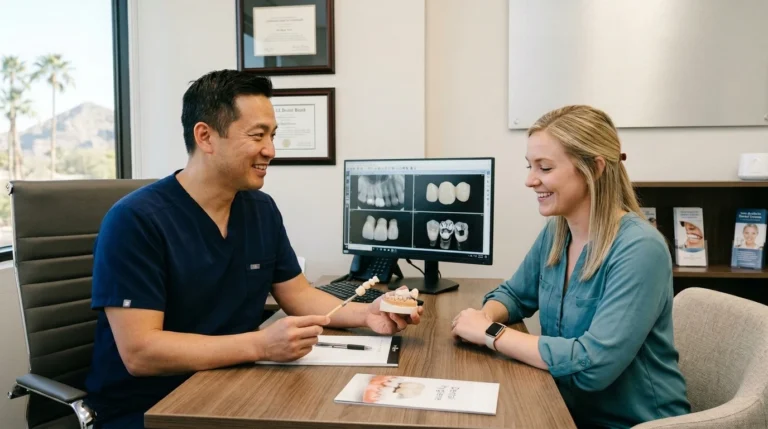
If you are weighing tooth replacement in North Phoenix, you have probably asked how long dental implants last before committing to one. It is a fair question for a treatment meant to be permanent, and the honest answer comes in two parts. The implant itself is built to last decades, while the visible crown on top is a part that wears and gets replaced over time. Here is what the long-term research shows, what shortens an implant's life, and how to get the most years out of yours.
How long do dental implants last?
Most dental implants last 20 years or more, and long-term studies report about 93 to 96 percent are still in place at 10 years. The titanium post can last decades, while the crown on top usually needs replacing around 10 to 15 years. Diamondback Dentistry places and maintains dental implants in North Phoenix.
Key takeaways
- 01An implant has two lifespans: the titanium post can last 20 years or more, while the crown on top is a wear part that often lasts 10 to 15 years.
- 02Across long-term studies, roughly 93 to 96 percent of implants are still working at 10 years.
- 03The biggest threats to longevity are gum infection around the implant, called peri-implantitis, and smoking. Both are largely manageable.
- 04Daily cleaning, a night guard if you grind, and regular checkups are what keep an implant healthy for decades.
- 05Diamondback Dentistry's single tooth implant package in North Phoenix is $2,875. Most single implants in Phoenix range from $3,000 to $5,000.
What "Lasting" Really Means: the Post vs. the Crown
When people ask how long an implant lasts, they usually picture one object. A dental implant is actually two parts with two different lifespans, and keeping them separate is the key to a clear answer.
The implant is a small titanium post placed in the jawbone. The visible tooth is a crown attached on top, usually through a connector called an abutment. The post is built to be permanent. The crown is built to be replaced.
The Implant Post (Titanium Fixture)
The post fuses to the bone in a process called osseointegration, where bone grows directly against the titanium and locks it in place. Per the American Dental Association, this bond is what gives an implant its strength. Once integrated, the post can stay healthy for 20 years or more, and for many patients it lasts the rest of their life.
What ends an implant early is almost never the metal failing. It is the gum and bone around it losing support. That is why day-to-day care of the tissue around an implant matters more than the implant material itself.
The Crown and Abutment (the Visible Tooth)
The crown takes the daily force of chewing, so it wears like any restoration. Most implant crowns last about 10 to 15 years before they need replacing, similar to crowns on natural teeth. Learn more about how dental implants work from post to crown.
Replacing a worn crown does not mean replacing the implant. In most cases the post stays exactly where it is and only the top is renewed, which keeps long-term costs lower than the alternatives.
Dental Implant Survival Rates by Year
Researchers track implants by survival rate, which is the share of implants still in function after a set number of years. The numbers are consistently high, but they are population averages, not a promise about any single tooth.
The 5-Year Survival Rate
In the first five years, implant survival is very high. Long-term studies of modern implants report survival in the range of about 95 to 98 percent over this window. Most failures that do happen occur early, before the crown is even placed, when an implant does not integrate with the bone. Clearing this first phase is a strong sign of a stable, long-lasting result.
The 10-Year Survival Rate
At 10 years, a 2019 systematic review and meta-analysis in the Journal of Dentistry put implant survival at about 96 percent, with a more conservative estimate near 93 percent once missing data was accounted for. In plain terms, the large majority of implants are still doing their job a full decade later. The review found slightly lower numbers, near 92 percent, for patients aged 65 and older.
Survival at 15 to 20 Years and Beyond
Implants routinely last well past 10 years. Long-term records show many implants still functioning at 15 and 20 years, and the post often outlives the original crown by a wide margin. Per the Cleveland Clinic, implants can last 20 years or more, and with good care many last a lifetime. The crown is usually what gets renewed along the way, not the post underneath.
10-year implant survival rate
A pooled analysis of long-term studies estimated that about 96 percent of dental implants were still in function at 10 years, with a more conservative estimate near 93 percent.
Source: Howe et al., systematic review and meta-analysis, Journal of Dentistry, 2019.
What Affects How Long Implants Last
Most of what determines an implant's lifespan is within your control. A handful of factors explain the majority of early failures, and nearly all of them can be managed.
Gum Health and Peri-implantitis
The leading threat to a long-lasting implant is peri-implantitis, an infection of the gum and bone around the implant that is driven by plaque. Left unchecked, it erodes the bone that holds the post. The encouraging part is that it is largely preventable with daily cleaning and routine professional care, and it is treatable when caught early.
Smoking and Grinding
Smoking is one of the strongest risk factors for implant problems. Research published by the National Library of Medicine found that smokers face roughly 2.6 times the risk of peri-implantitis compared with non-smokers, along with more bone loss over time. Heavy grinding, called bruxism, also shortens crown life by overloading it, which is why a night guard is often recommended.
Bone Quality and General Health
Implants need enough healthy bone to anchor into, so untreated gum disease or significant bone loss lowers long-term success. If you are missing bone, a graft can often rebuild the site first. Read more about dental implants with bone loss. Well-managed general health helps too, since conditions like uncontrolled diabetes can slow healing and raise the risk of complications.
Placement and Restoration Quality
How an implant is planned, placed, and restored matters for the long run. Correct positioning, a well-fitted crown, and a balanced bite all reduce stress on the implant. This is one reason an unhurried consultation and treatment plan, rather than a rushed placement, pays off over decades.
How to Make Your Dental Implants Last Longer
Implants are low maintenance, not no maintenance. The habits that protect them are the same ones that protect natural teeth, with a few specifics.
Daily Care at Home
Brush twice a day and clean between your teeth once a day. Many patients find a water flosser or soft interdental brushes easier to use around an implant crown. If you grind your teeth at night, wear the night guard your dentist provides. These small habits are what keep the gum and bone around the post healthy.
Professional Maintenance
See your dentist for regular cleanings and exams so any early gum changes are caught before they reach the bone. Most patients do well with visits every six months, though some need them more often. Diamondback Dentistry is open Monday to Wednesday from 8 AM to 4 PM and Thursday from 9 AM to 2 PM, and the team will set a recall schedule that fits your case.
Signs of Implant Trouble and When to Call a Dentist
A healthy implant should feel stable and comfortable. Certain changes are worth a prompt call rather than a wait-and-see approach.
Early Warning Signs
Watch for gums that are red, swollen, or bleed around the implant, a crown that feels loose, lingering soreness, or gum that is pulling back from the tooth. On its own, an implant should not move or ache. Any of these can signal peri-implant inflammation, which is easier to reverse the sooner it is treated.
When to Seek Care Promptly
Call a dentist within a day or two if an implant feels loose, if you notice pus or a bad taste near it, or if pain and swelling are getting worse instead of better. If you have severe facial swelling along with trouble breathing or swallowing, treat that as an emergency, seek urgent care, and call 911. Most implant problems are fixable when they are addressed early.
Who Gets the Longest-Lasting Results
Implants work for most adults missing one or more teeth, and the patients who get the most years out of them tend to share a few traits.

The Best Candidates
The strongest long-term results come from patients with healthy gums, enough jawbone to support the post, good overall health, and a commitment to regular care.
Healthy Gums and Enough Bone
Stable gums and adequate bone give the post a solid foundation. When bone is thin, a graft can often build it back up before placement. You can check whether you are a candidate for dental implants in Phoenix with our team.
Good General Health and Non-smoker
Patients in good general health who do not smoke heal more predictably and keep their implants longer.
A Commitment to Maintenance
An implant rewards consistent home care and routine checkups. Patients who keep up with both see the longest service.
When Implants May Not Be the Right Fit
Implants are not automatically the best choice for everyone. Uncontrolled diabetes, active gum disease, heavy smoking, and untreated grinding can lower success rates. None of these is always a permanent barrier. If any apply to you, talk with a dentist about treating them first, since many patients become good candidates once the underlying issue is managed.
Implant Longevity vs. Bridges and Dentures
Compared with the main alternatives, implants are the most durable way to replace a missing tooth. A traditional bridge typically lasts about 10 to 15 years and relies on grinding down the neighboring teeth. Dentures usually need relining or replacing every 5 to 10 years as the jaw changes shape. An implant stands on its own and, with care, can outlast both. If you are weighing the options, our guide to implants vs. bridges vs. dentures in North Phoenix breaks down the trade-offs.

Dental Implants in North Phoenix: What They Cost
Because an implant can last decades, its cost is spread over a long service life. In Phoenix, a single dental implant typically costs $3,000 to $5,000 including the crown. Diamondback Dentistry offers a single tooth implant package at a set price, and you can see the full breakdown on our dental implants cost page for Phoenix. Your cost depends on your specific case.
North Phoenix Implant Package
Single Tooth Implant Package
What's included
- Implant consultation and treatment plan
- Surgical placement of the implant post
- Final restoration (the crown)
Final inclusions are confirmed at your consultation. Prices vary based on individual case complexity. Request a consultation for an accurate estimate.
Book a ConsultationCommon Questions About Dental Implant Longevity
How long do dental implants last on average?
▾
Do dental implants last forever?
▾
How long do the crowns on implants last compared with the implant itself?
▾
What is the failure rate of dental implants?
▾
What causes a dental implant to fail or wear out early?
▾
Can a failed or worn-out implant be replaced?
▾
How do I make my dental implants last as long as possible?
▾
How much do dental implants cost in North Phoenix?
▾
Sources and References
- Howe M-S, Keys W, Richards D. Long-term (10-year) dental implant survival: A systematic review and sensitivity meta-analysis. Journal of Dentistry, 2019. 10-year implant survival estimated near 96 percent (93 percent in the conservative analysis).
- Cleveland Clinic. Dental Implants. Implants can last 20 years or more, and many last a lifetime with good care.
- American Dental Association. Implants (MouthHealthy). Osseointegration: bone grows around the implant and holds it in place.
- The Long-Term Effect of Smoking on 10 Years' Survival and Success of Dental Implants. National Library of Medicine, 2020. Smokers showed roughly 2.6 times the risk of peri-implantitis versus non-smokers.
- Peri-Implantitis. National Library of Medicine. Inflammatory disease of the tissue around implants; a leading cause of late failure.
Talk Through Your Implant Options
Diamondback Dentistry plans every implant case with an unhurried consultation, a clear treatment plan, and pricing up front. If it has been a while since your last visit, that is okay. Book a consultation in North Phoenix or call our team.
Serving North Phoenix and the North Valley
Diamondback Dentistry places and maintains dental implants for patients across North Phoenix and the surrounding North Valley.
Neighborhoods served
- North Phoenix
- Deer Valley
- Peoria
- Moon Valley
- Glendale
ZIP codes in catchment
- 85023
- 85022
- 85021
- 85029
- 85051
- 85027
Diamondback Dentistry · 1512 W Bell Rd, Suite C-6, Phoenix, AZ 85023 · (602) 866-8183